Other Crops Growing Costs
This page is used to calculate the variable costs per hectare from growing crops other than cane on fallow blocks. In addition to the sections contained in Cane Growing Costs, there are 3 additional categories, Other Crop Costs, Harvesting Costs and Packing Costs.
Once you have entered information for one growing cost page, click the next tab to navigate to the next crop entry.
- It is possible to copy operations from one crop to the new tab, but it needs to be from the same crop grouping (either legumes, peanuts or other crops).
- Note: Please see headings in the Cane Growing Costs section for step-by-step details on how to enter information for Land Preparation, Planting, Fertiliser, Weed/Insect/Disease Control and Irrigation. Step-by-step details for entering information for Machinery Operations are available in the Machinery Setup section.
Other Crop Costs
Trellising Costs
1. Trellising costs can be added either by a contractor or self.
2. If added by a contractor add in the labour rate ($/hr), contractor cost ($/ha), and any additional labour (hrs).

3. If added by self, record any materials (such as posts and wire) in the Assets page and the full depreciation schedule in the Depreciation page.
- Then add in the labour hours and cost ($/hr) for trellis installation and removal.

Drip and Plastic Mulch Costs
The first section of the template is used to calculate the cost of the inputs per hectare per crop.
1. Add drip irrigation and plastic mulch installation costs by clicking on "Add Drip and Plastic Mulch costs" button.
- Note this only includes the product and labour application costs.
- Any associated machinery involvement needs to be captured by clicking on the "Add Machinery Operation" button in the same section.
- Ensure all fields are filled.
- If not required, enter zero (0).
- Note: Row width is imported from Scenario Assumptions.
2. Add how much dripline is used per bed.
3. Spray path after how many beds is used where land is set aside within the crop for sprayers or harvesters to travel without driving over the crop (e.g. watermelons) and refers to the amount of planted beds between spray paths (e.g. 10).
- This would indicate that the one sprayer boom covers 5 beds across on the way down, and 5 on the way back the next spray path.
- Where there are access / spray paths, indicate the width of these unplanted areas in terms of the equivalent number of beds (e.g. 2).
- This will ensure the amount of dripline required per hectare is correct.
- If the crop is planted on continuous beds without any discrete spray paths, enter 0.
4. Add the width, measured in how many beds of spray path.
5. Add the lay-flat requirement (m/ha).
6. Add dripline/lay-flat/mulch costs which are measured per linear metre (e.g. $0.11/m).
- If it is priced in rolls, convert to a per metre basis.
- Dripline will vary in length according to type and wall thickness, but is usually between 800 and 2300m in length.
7. Add dripline/lay-flat/mulch lifespan in terms of crops.
- Where dripline, lay-flat or mulch is reused on multiple plantings/crops, indicate how many crop cycles it will be used.
- Often dripline and mulch is used only once or twice, but lay-flat usually lasts for numerous crops.

The second section of the template captures the labour installation and removal costs.
8. Input total labour hours per operation (excluding the tractor driver hours, which will be captured in "Add Machinery Operation").
- For example, if the tractor driver and 2 extra people take 3 hours to install one hectare of dripline, input 6 in the Labour Hours/ha column (2x3=6).

Harvesting Costs
1. Add harvesting costs by clicking on the "Add Harvest Cost" button.
2. Enter a name or description. For example, soy harvest contractor A.
3. Choose whether the operation is completed with "Own Tractor" or "Contractor".

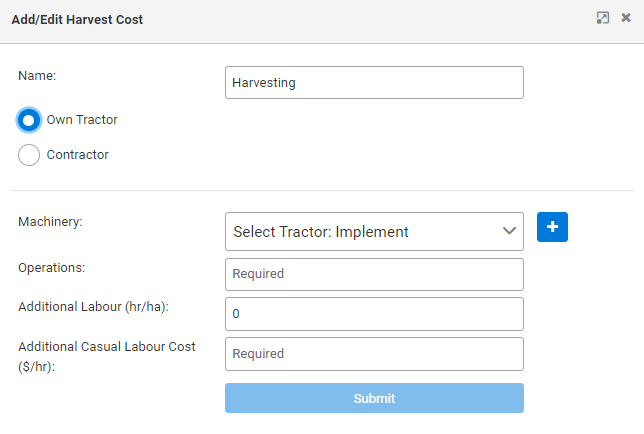
Harvesting with own tractor
1. Select or add a machinery item for the operation.
2. Enter the number of operations.
3. Enter any additional labour in hours per hectare (hrs/ha).
4. Enter any additional casual labour cost in dollars per hour ($/hr).
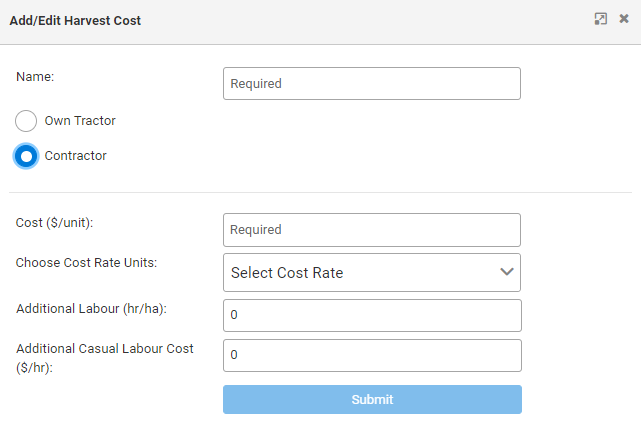
Harvesting with contractor
1. Enter the cost in dollars per unit ($/unit).
2. Choose the cost rate units from the drop down box of either $/ha or $/yield unit. For example, the yield unit could be wet and dirty yield in tonnes or cartons.
3. Enter any additional labour in hours per hectare (hrs/ha).
4. Enter any additional casual labour cost in dollars per hour ($/hr).
- Drying costs can also be added here with as the cost ($/ha), and cost rate units ($/yield unit) added in.
Desiccation Costs
Desiccation costs can be included in the weed control section. Please make sure you name it as “Desiccation costs” and/or add further details in the name.
- Note: By placing desiccation in these sections please be aware that you may have machinery operations which are for the application of chemicals and machinery operations for desiccation.
Packing Costs
Packing costs will not be applicable for all crops, but are often a major component of vegetable crop gross margins. There is a packing calculator to help capture the various labour and other input costs.
Packing costs can either be inputted as a sum of multiple categories in Self or via a set rate per unit in the Contractor section.
Self
Complete the template by inserting a labour cost per hour, and working out the equivalent labour rate (hrs/ha) for the following categories:
- Washing
- Sorting / Grading / Trimming
- Packing costs (labour only)
- Other labour costs (loading, cleaning, QA, admin, etc.).
- These are all inputted in terms of how many labour hours would be used to complete the task for one hectare's worth of production.
In addition to labour costs, there are other categories, including:
- Packing materials (e.g. boxes, cartons, ice, strapping)
- Shed costs (e.g. electricity, R&M consumables)
- Equipment hire (e.g. pallets, bins, forklift, cooling equipment)
- Miscellaneous costs (e.g. detergents, fungicides. inspection costs).
These need to be converted into a total cost per hectare equivalent for each category.
- Note: the final paid weight yield is copied across from Other Crop Assumptions, and displays the various costs in terms of $/unit.
- This can be used to sense check if the per hectare rates are reasonable.

Contractor
Click on the Contractor button, and enter the name, Contract packing cost ($/unit), and Additional costs ($/ha).
- This will convert the figures into a total cost ($/ha).
